If you are nearing the end of a commercial lease, you may have come across the word dilapidations – often in a letter that feels formal and slightly alarming. Landlords may also hear the term when preparing to re-let or sell a commercial property.
In simple terms, dilapidations relate to repair responsibilities. They are not a penalty and are not unusual. They arise from the obligations set out in a lease agreement.
Understanding what they are and who is responsible can remove a great deal of uncertainty.
What Are Dilapidations?
Dilapidations refer to items of disrepair or damage that fall under a tenant’s repair obligations in a commercial lease. Put simply, they are works needed to bring a property back to the condition required by the lease. This might include repairs, maintenance, decoration or removing alterations made during the tenancy.
Dilapidations usually arise because the lease says the tenant must:
- Keep the property in repair
- Maintain certain elements
- Redecorate at set intervals
- Reinstate (remove) alterations at the end of the term
If those obligations have not been met, a dilapidations claim may follow.
What Is a Commercial Lease and Why Does It Matter?
A commercial lease is the legal agreement between landlord and tenant. It sets out each party’s responsibilities, including who must repair and maintain the property.
Some leases are known as “full repairing and insuring” leases (often shortened to FRI). In these arrangements, the tenant usually takes on broad responsibility for repairs and upkeep.
However, not all leases are identical. The wording matters.
Two tenants in similar buildings may have very different obligations depending on what their lease says. That is why reviewing the lease carefully is essential before deciding who is responsible for dilapidations.
When Do Dilapidations Arise?
Dilapidations can arise during the lease term or, more commonly, at the end of the lease.
During the Lease (Interim Dilapidations)
Sometimes a landlord inspects the property partway through the lease.
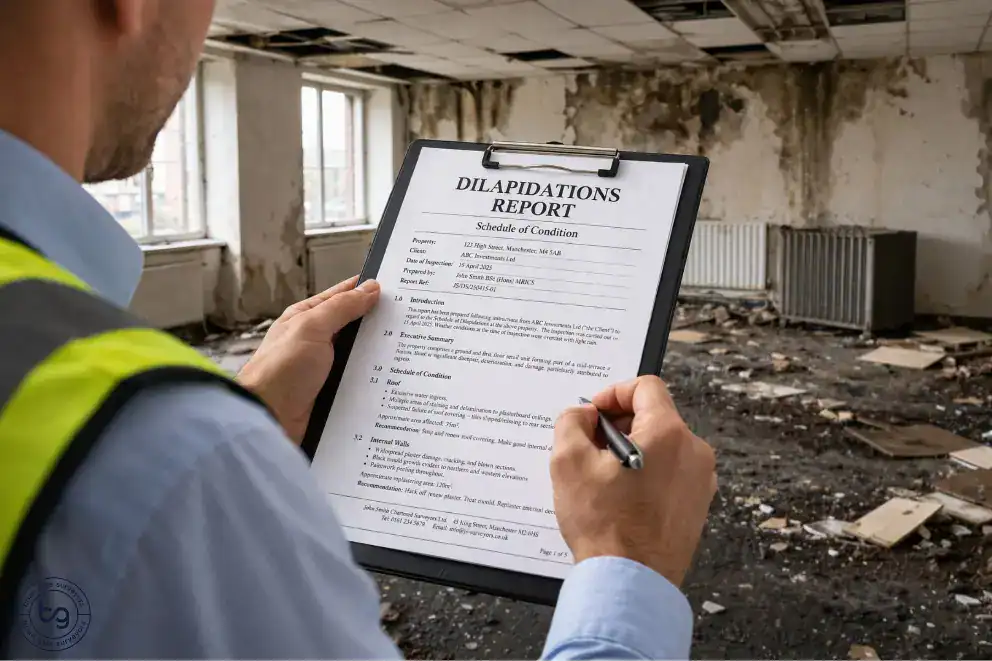
If repair issues are found, the landlord may issue a schedule of dilapidations – a document listing items that require attention.
This allows the tenant to carry out works during the lease, rather than leaving everything until the end.
At the End of the Lease (Terminal Dilapidations)
This is the most common scenario.
As the lease approaches expiry, the landlord will inspect the property to assess its condition. A schedule of dilapidations may then be prepared, setting out the repairs, decoration and alteration reinstatements required.
This then forms the basis of a potential claim.
Who Is Responsible for Dilapidations?
Responsibility depends on three key factors:
- The wording of the commercial lease
- The condition of the property at the start of the lease
- Whether a schedule of condition was agreed
A schedule of condition is a record, often supported by photographs, showing the state of the property when the tenant took occupation. If one exists, it may limit the tenant’s repair liability to that original condition.
In many commercial leases, tenants are responsible for repairs and internal maintenance. In some cases, landlords may retain responsibility for structural elements – but this varies.
There is no universal rule. Each case must be assessed individually. Assumptions can be costly.
What Does a Dilapidations Claim Usually Include?
A dilapidations claim can cover a range of issues, depending on the lease terms and the condition of the property.
Common examples include:
- Repairs to walls, ceilings and floors
- Roof repairs
- Servicing or repair of heating and electrical systems
- Replacement of damaged fixtures
- Redecoration
- Removal of partition walls or signage added by the tenant
Not every item will necessarily result in a full payment. Claims are often negotiated and the final settlement may differ from the original schedule.
The aim is usually to reflect the landlord’s actual loss rather than create a windfall.
How Is a Dilapidations Claim Calculated?
The figure in a dilapidations claim is generally based on:
- The reasonable cost of repair works
- Associated professional fees
- In some cases, loss of rent if the property cannot be re-let immediately
However, there are legal principles that limit what a landlord can recover. The claim must broadly reflect the reduction in the property’s value caused by the disrepair, rather than simply the total cost of works.
This is why professional advice is crucial. An initial figure is rarely the final agreed sum.
The Role of a Dilapidations Surveyor
A dilapidations surveyor specialises in assessing and advising on repair liabilities under commercial leases.
Their role includes:
- Reviewing the lease in detail
- Inspecting the property
- Preparing a schedule of dilapidations (for landlords)
- Assessing and responding to a claim (for tenants)
- Advising on realistic repair costs
- Negotiating a fair settlement
The aim is to provide clarity and avoid unnecessary dispute. Having professional input ensures the claim is based on evidence and reflects the actual obligations set out in the lease.
Why Instruct a Commercial Property Surveyor Early?
Seeking advice from a commercial property surveyor well before lease expiry can prevent unexpected costs.
For tenants, early advice can:
- Clarify repair responsibilities
- Identify works that can be addressed gradually
- Help with budgeting
- Reduce the risk of a large end-of-term claim
For landlords, early inspection can:
- Protect the property’s condition
- Ensure lease obligations are being met
- Support smoother reletting
Leaving matters until the final months of a lease often limits options and increases stress.
Practical Steps for Tenants Approaching Lease End
If your commercial lease is nearing expiry, consider the following:
- Review the lease at least 12–18 months before the end date
- Check whether a schedule of condition was agreed at the start
- Arrange an inspection to understand potential liabilities
- Do not ignore a schedule of dilapidations if one is received
- Keep communication open with the landlord
Understanding Dilapidations And Avoiding Disputes
Dilapidations are a standard part of many commercial leases. They arise from repair obligations agreed at the outset of the tenancy.
Responsibility depends on the lease wording and the property’s condition when the lease began. Claims can be assessed carefully and negotiated professionally. With clear advice and early planning, dilapidations do not need to become a dispute.
If you are a landlord or tenant in Reigate or the surrounding area and would like straightforward advice on dilapidations, speak to an experienced commercial property surveyor at Brian Gale Surveyors. We remove uncertainty and give you clarity on what is reasonable and what comes next.