
A survey and a valuation are not the same thing. Confusing the two is one of the most common and costly mistakes buyers make.
A valuation, usually arranged by your mortgage lender, simply confirms the property is worth what you are paying.
A survey, arranged by you, assesses the property’s condition.
In most cases you need both, and the survey should be arranged once your offer is accepted, alongside or shortly after the mortgage valuation.
What is a valuation?
When buyers talk about a valuation during a purchase, they usually mean a mortgage valuation.
A mortgage valuation is carried out for the lender’s benefit. Its purpose is to confirm that the property provides adequate security for the loan. The lender wants to know that, if you default, the property could be sold to recover the outstanding mortgage.
Although you usually pay the fee, the report is not prepared for you. In many cases:
- The inspection is brief
- It may be a desktop or drive-by assessment
- It focuses on value rather than condition
- You may not receive a detailed copy of the report
The valuer is not assessing whether the property is a good purchase for you. They are assessing whether it is a safe loan for the bank.
Independent valuations can also be commissioned outside the mortgage process, for example for tax, probate or matrimonial matters.
Read more about our property valuation services if you require a formal RICS Red Book valuation for a specific purpose.
For a typical buyer using a mortgage, however, the lender’s valuation is a lending check, not a condition survey.
What is a survey?
A survey is commissioned by you, the buyer, and it is for your benefit.
Its purpose is to assess the physical condition of the property and highlight defects, risks and potential future costs. A survey provides information you can use to:
- Decide whether to proceed
- Renegotiate the purchase price
- Budget for repairs
- Withdraw before exchange of contracts if serious issues are identified
There are three main RICS survey levels:
The appropriate survey depends on the age, type and condition of the property. If you are unsure which survey you need when buying a house, the Level 2 is commonly chosen for conventional properties in reasonable condition, while the Level 3 is more suitable for older, altered or non-standard buildings.
Unlike a valuation, a survey looks at issues such as structural movement, damp, roof condition and visible defects. It is about the building itself, not the loan.
The key differences, side by side
Understanding the difference between survey and valuation becomes much clearer when set out directly.
| Feature | Mortgage Valuation | Survey |
|---|---|---|
| Who is it for? | The lender | The buyer |
| Who pays? | Usually the buyer | The buyer |
| What does it assess? | Market value for lending purposes | Condition of the property |
| Depth of inspection | Brief, sometimes desktop | Detailed visual inspection |
| Can you use it to renegotiate? | No | Yes |
| Will you receive a full report? | Not always | Yes |
This demonstrates why it is not really a case of choosing one or the other. They serve different purposes.
Which do you need first?
This is the question most buyers are really asking.
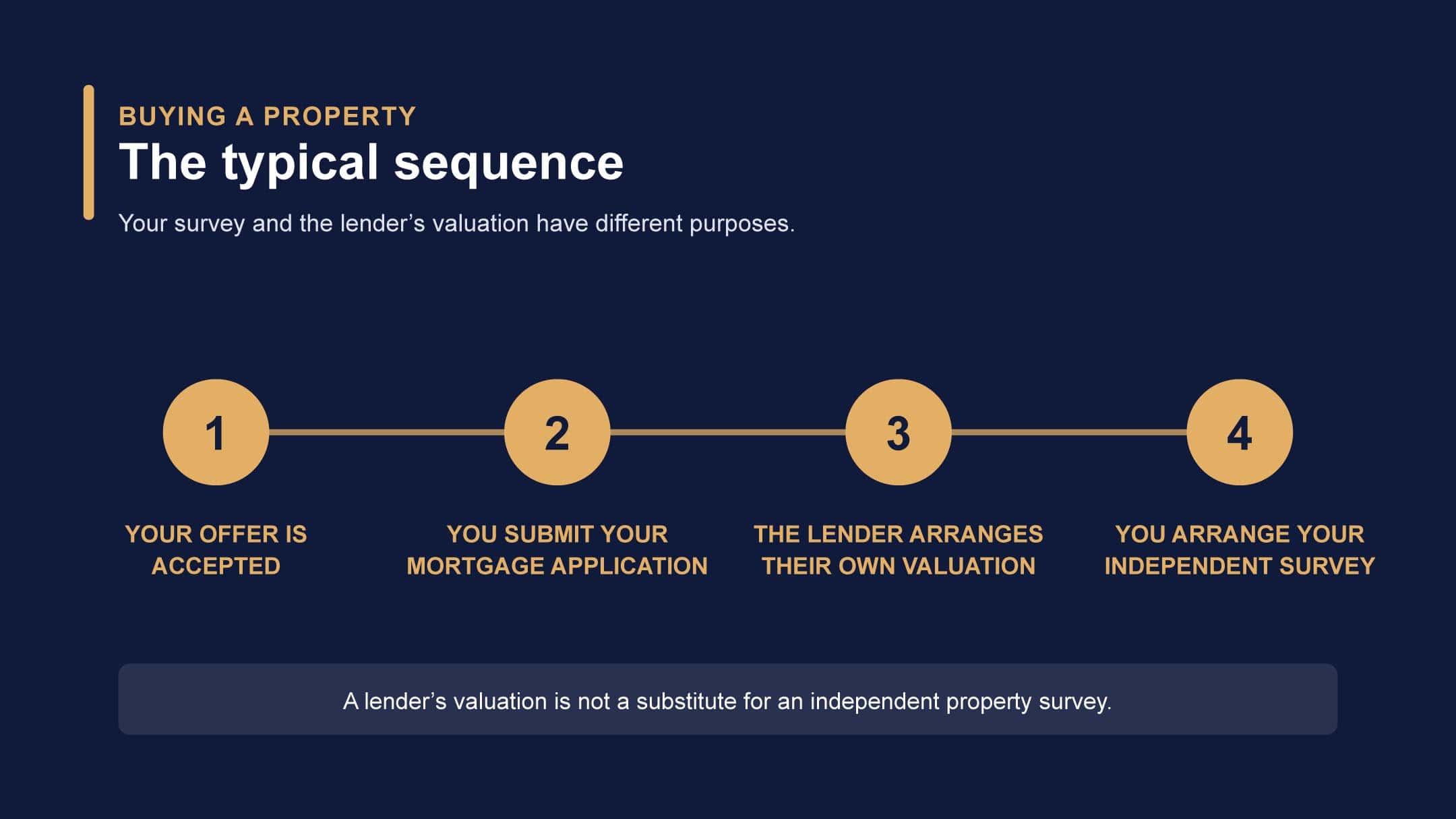
In practice, the survey and the valuation are often arranged around the same time. You do not need to wait for the mortgage valuation to be completed before booking your survey.
What matters is that your survey is carried out and the report received before you exchange contracts. Exchange is the point at which you become legally committed. Once you exchange, you cannot withdraw without significant financial consequences.
The survey gives you the opportunity to renegotiate or walk away if necessary. The mortgage valuation does not provide that protection.
If timing is tight, arranging your survey as soon as your offer is accepted is usually sensible.
Do you need both a survey and a valuation?
In almost all cases, yes.
A mortgage valuation alone does not tell you whether the property has problems. It does not investigate condition in any depth and will not highlight most defects.
One of the most common and expensive mistakes buyers make is assuming that because a lender has “valued” the property, it must be structurally sound. That is not what the valuation is designed to confirm.
A survey is the only way to understand:
- Whether there are signs of structural movement
- Whether damp is present
- Whether the roof or services may need repair
- Whether alterations appear to have been carried out properly
Survey findings can be used to renegotiate the price or request works. A valuation cannot be used in this way because it is not assessing condition.
What if you are buying without a mortgage?
If you are a cash buyer, there is no automatic mortgage valuation. That means there is no lender safety check at all.
In this situation, the survey becomes even more important. You are relying entirely on your own due diligence.
Some cash buyers also choose to commission an independent valuation for reassurance that they are paying a fair price, particularly in competitive markets. Others may require a valuation for tax or legal reasons.
Without a lender involved, the responsibility for both value and condition rests solely with you.
Mortgage valuation vs survey: clearing up common misconceptions
Will a mortgage valuation tell you if the property has problems?
No. A mortgage valuation focuses on value for lending purposes. It may be completed in a short visit and sometimes without entering the property. It will not identify damp, structural movement or other defects in detail.
Can a survey replace the lender’s valuation?
In some cases, yes. If your lender approves your chosen surveyor and the survey includes a valuation, such as a Level 2 Homebuyers Survey with valuation, it may be accepted in place of a separate mortgage valuation. This must be agreed with the lender in advance.
You should check with both your lender and your surveyor before booking if you want the survey to double up as the mortgage valuation.
Do I need a survey if I am getting a mortgage valuation?
Yes. A mortgage valuation only confirms that the property is adequate security for the loan. It does not assess condition in detail. A separate survey is the only way to identify defects before you commit to the purchase.
What happens if you skip the survey?
If you skip the survey, you are relying on your own observations and the lender’s limited valuation.
If significant defects are discovered after completion, you will have limited recourse. The cost of structural repairs or remedial works can run into thousands of pounds.
A survey is not a guarantee that nothing will go wrong, but it significantly reduces the risk of unpleasant surprises.
Survey or valuation: clarifying your priorities
The difference between survey and valuation is clear once you separate their purposes.
- A valuation protects the lender.
- A survey protects you.
They are not alternatives. They are complementary.
If you are buying with a mortgage, the lender will arrange their valuation as part of the application process. Your role is to arrange your own independent survey in good time before exchange of contracts.
If you are unsure which survey level is appropriate for your purchase, or whether you require a valuation for a specific reason, contact us for guidance or get a quote for the relevant service.
Brian Gale Surveyors provides all three RICS survey levels and RICS Red Book valuations across Surrey, Sussex, Kent, Hampshire and London. Clear advice at the outset helps you commission the right report and move forward with confidence.
Survey vs Valuation FAQs
- Do I need a survey if I am getting a mortgage valuation?
Yes. The lender’s valuation protects the bank’s interests and does not provide detailed advice about the property’s condition or likely repair costs.
- Which should I arrange first, the survey or the valuation?
The lender will arrange their valuation as part of your mortgage application. You should book your survey early enough for the report to be reviewed before exchange of contracts.
- Will a mortgage valuation tell me if the property has problems?
No. It focuses on confirming the property’s value for lending purposes and does not investigate defects in detail.
- Can my survey double up as my mortgage valuation?
Sometimes, if the lender agrees and the survey includes a valuation carried out by an approved surveyor. This must be confirmed in advance, otherwise the lender may still instruct their own valuation.